Making Surveillance Visible - the limits of visibility cannot define the limits of our knowledge about surveillance. There’s a need for conceptual and empirical engagement with expanding surveillance apparatuses.
Surveillance apparatuses thrive by both opacity and visibility. Their panoptic effect – regulating behaviour by making people suspect that they’re under surveillance – works though if not visibility then at least insinuation of presence. But exact knowledge of surveillance is deemed a threat to its ability to monitor us while keeping the extent of that monitoring opaque.
I have worked to understand and counteract this opacity in various ways. This includes theoretical work that unearths the ‘monstrous’ character of surveillance – as something that is often present but mostly invisible, like a monster in a horror movie.
Read more:
Elsewhere the power asymmetries enacted in surveillance are not as stark or violent, but they are not absent. My collaborative project UNDO works to map surveillance in Nordic cities.
Further reading:
Andersen, R. S., & Möller, F. (2013). Engaging the limits of visibility: Photography, security and surveillance. Security Dialogue, 44(3), 203–221. https://doi.org/10.1177/0967010613484955
Saugmann, R. (2018). The art of questioning Lethal Vision: Mosse’s infra and militarized machine vision. Electronic Workshops in Computing. https://doi.org/10.14236/ewic/evac18.29
Saugmann, R., Möller, F., & Bellmer, R. (2020). Seeing like a surveillance agency? Sensor realism as aesthetic critique of visual data governance. Information Communication & Society, 23(14), 1996–2013. https://doi.org/10.1080/1369118x.2020.1770315
Counteracting this absent-presence is important to de-mystify surveillance and provide a foundation for laying bare the power relations it operates and enacts. Artists like Trevor Paglen, Simon Norfolk and Richard Mosse have done important work that have inspired me to try to visualise surveillance.
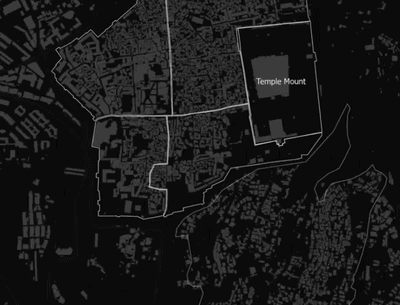
In Occupied East Jerusalem, surveillance functions to embed the occupation and the unequal power relations further into the urban landscape. Together with colleagues, I have mapped a densely surveilled and fiercely contested area of the city, where surveillance, tourism and underground archeological excavations combine.
Saugmann, Rune. (2018). Surveillance. In Bleiker (ed., 2018) Visual Global Politics. Visual Global Politics.